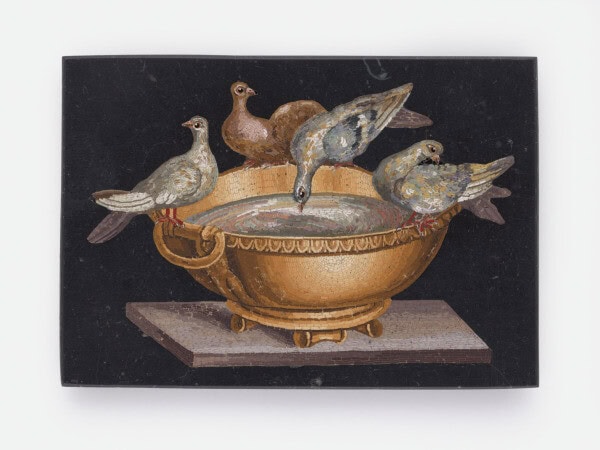
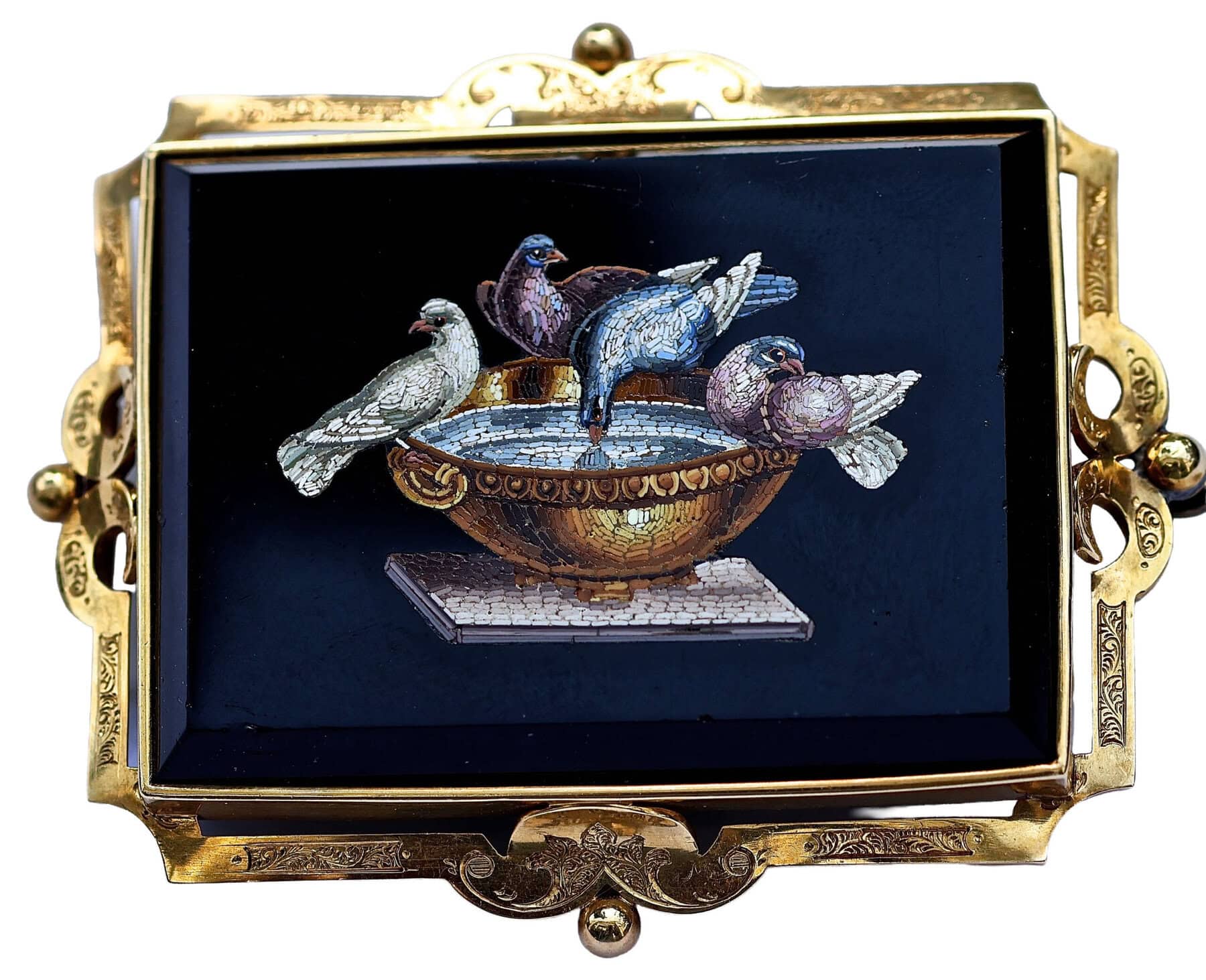
Barberi’s Doves of Pliny
A fine micromosaic circa 1830 -1840, attributed to Gioacchino Barberi. Barberi (1783–1857) was a premier mosaicista. His workshop located at 99 Piazza di Spagna, catered to elite international travellers on the Grand Tour, European nobility, and imperial courts. His highly detailed glass tesserae mosaics were prized luxury souvenirs. Barberi is widely credited with pioneering the use of opaque black glass enamel (smalti) for his background fields, a stylistic choice inspired by ancient wall paintings discovered in Herculaneum.
The discovery in 1737 of an ancient mosaic of the Doves of Pliny created renewed interest in Roman mosaic techniques. Cardinal Furietti, the excavator of the ancient mosaic, believed it to be the original mosaic executed by Sosos of Pergamon as described to Pliny, though it is now believed to be a copy made for Emperor Hadrian in the 2nd century.
This Barberi mosaic of the Doves of Pliny is of rectangular form with cavetto edging set to an 18 carat gold engraved brooch mount. The quality of the mosaic work is exceptional, with microscopic detail including both the dove’s reflection and ripples in the water, a feature rarely achieved. The brooch measures 2 and 1/3 inches by 2 inches and is immaculate.
sold
Item ref : SL2


a similar Barberi mosaic of the Doves of Pliny in the Virginia Museum of Fine Arts below